





ADI and Xilinx Components in Robotics and Drone Systems
Robotics and unmanned aerial vehicles (UAVs) rely heavily on high-performance signal processing, real-time control, and low-latency data handling. In these systems, FPGAs and mixed-signal ICs play a critical role in enabling fast decision making, sensor fusion, and reliable communication.
At LXB Semicon, we work closely with engineers and procurement teams who are developing industrial robots, autonomous drones, machine vision platforms, and intelligent control systems. Many of these applications are built around components from Analog Devices and Xilinx, particularly the well-proven Virtex-4 and Virtex-5 FPGA families.
These devices are widely used in robotics and UAV platforms where parallel processing capability, deterministic timing, and hardware acceleration are required.
Why FPGAs Are Critical in Robotics and UAV Systems
Compared with traditional microcontrollers or CPUs, FPGA devices provide several advantages for robotics platforms:
1. Real-time parallel processing
Robots and drones process multiple sensor inputs simultaneously:
Cameras
LiDAR
IMU sensors
Radar
Motor feedback
FPGAs allow engineers to implement parallel hardware pipelines, reducing latency significantly.
2. Deterministic control
Motor control loops and flight stabilization require microsecond-level deterministic timing, something that FPGA architectures handle very well.
3. Hardware acceleration for AI and vision
Many robotics platforms implement edge AI or computer vision algorithms, such as:
Object detection
SLAM mapping
Obstacle avoidance
Visual navigation
FPGA DSP slices can accelerate these tasks efficiently.
Xilinx Virtex FPGA Devices Used in Robotics Platforms
Several FPGA devices from the Virtex-4 and Virtex-5 families remain widely deployed in industrial robotics and UAV designs.
For example, devices such as
XC4VFX100-11FFG1517C and
XC4VSX55-10FFG1148I
provide a strong combination of logic density, DSP resources, and high-speed serial connectivity, making them suitable for motion control and sensor data processing.
Other commonly used models include:
These devices are often deployed in:
industrial robotic arms
machine vision controllers
autonomous navigation systems
UAV flight control subsystems
For systems that require more processing capability, engineers frequently select Virtex-5 FPGA devices, such as:
These devices integrate PowerPC processors, high-speed transceivers, and advanced DSP resources, making them ideal for applications such as:
high-speed sensor data fusion
radar signal processing in drones
real-time image processing
AI acceleration at the edge
For compute-intensive designs, the Virtex-5 SX series, including devices like XC5VSX95T and XC5VSX240T, are also frequently used because of their high DSP slice density, which is particularly valuable for control algorithms and signal processing workloads.
The Role of Analog Devices in Robotics and UAV Electronics
While FPGAs handle high-speed processing tasks, Analog Devices components provide the precision sensing and signal conversion required by robotics platforms.
Typical ADI devices used alongside FPGA architectures include:
high-accuracy IMU sensors
data converters (ADC/DAC)
RF transceivers
power management ICs
motor control drivers
These components enable reliable acquisition of data from:
inertial navigation systems
cameras
radar sensors
motor feedback loops
By combining ADI’s analog precision with Xilinx FPGA processing capability, engineers can build high-performance robotic systems with extremely low latency and high reliability.
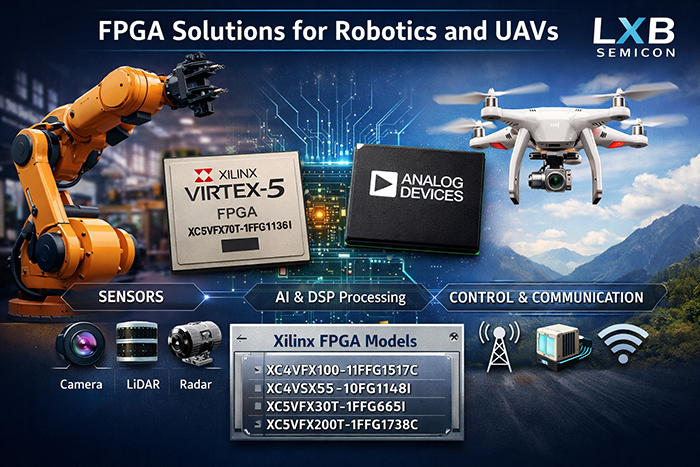
Typical Robotics and Drone System Architecture
A simplified robotics control architecture may include:
Sensor Layer
IMU (ADI)
Vision cameras
LiDAR
Radar
Processing Layer
Virtex-4 / Virtex-5 FPGA
real-time DSP pipelines
hardware AI acceleration
Control Layer
motor control algorithms
flight stabilization logic
safety monitoring
Communication Layer
high-speed serial interfaces
Ethernet
wireless telemetry
This architecture allows robotics platforms to perform complex decision-making within milliseconds.
Component Supply and Engineering Support
At LXB Semicon, we support robotics manufacturers, system integrators, and design engineers with reliable sourcing of FPGA and analog components used in industrial automation and UAV development.
Our available inventory frequently includes devices such as:
Virtex-4 LX / SX / FX series
Virtex-5 FX and SX series
high-performance analog components from ADI
These components continue to be used in many long-lifecycle industrial platforms, where maintaining compatibility with existing hardware designs is essential.
✔ Conclusion
As robotics and drone technology continues to evolve, real-time data processing and sensor integration will remain central challenges. Combining the signal processing power of Xilinx FPGAs with the precision analog technology of Analog Devices provides a proven architecture for building reliable autonomous systems.
With extensive component availability and industry experience, LXB Semicon helps engineering teams maintain and scale robotics platforms with trusted semiconductor solutions.